
The hurdy gurdy (vielle) has existed in numerous shapes and forms since at least the 12th century – indeed, few instruments have enjoyed such a varied and colourful history, from use in the medieval church, to accompaniment of songs of courtly love, before abandoning its place in “high” culture to be primarily found in the hands of blind musicians, beggars and peasants for several centuries, until its revival in 18th century France. A true golden age, the vielle of the 18th century was adopted by and adapted for the nobility, becoming a true classical instrument in its own right; with hundreds of compositions written for it, a group of virtuosic professional players pushing its limits – technical and musical – to new heights, and supported by an enthusiastic and very fashionable group of amateurs of the upper classes, including the queen, Marie Leszcynska, wife of Louis XV. The vielle which developed over the course of the 18th century, would become the inspiration for generations of traditional instruments following the French revolution, however the level of lutherie and innovation relating to the vielle would not again be reached until the current revival of the instrument, beginning in the last decades of the 20th century.
One of the most innovative – and perhaps niche – innovations of the 18th century vielle, was to add organ pipes to the instrument, inventing the so-called “vielle organisée” (“lira organizzata”). The concept of adding organ pipes to an existing instrument was nothing new (claviorgans were an established part of the 18th century instrumentarium) – indeed, the “épinette organisée” can be traced at least to the 15th century with certainty (Don Sancho de Paredes possessed two épinettes organisées in 1480), and the English king Henry VIII is later recorded as having four of the instruments in his possession. Additionally, vielle and organ have a shared common history since the middle ages – the earliest hurdy gurdies (“organistrum”) incorporated the technology of organ making (key sliders etc.) together with that of the bow and monochord, for use in the church to teach and accompany singing. Iconography during the following century often shows the two instruments depicted together – smaller, one-person organistra and organ, offering a marriage of bowed strings and wind, bound together by the common element of possessing a keyboard.
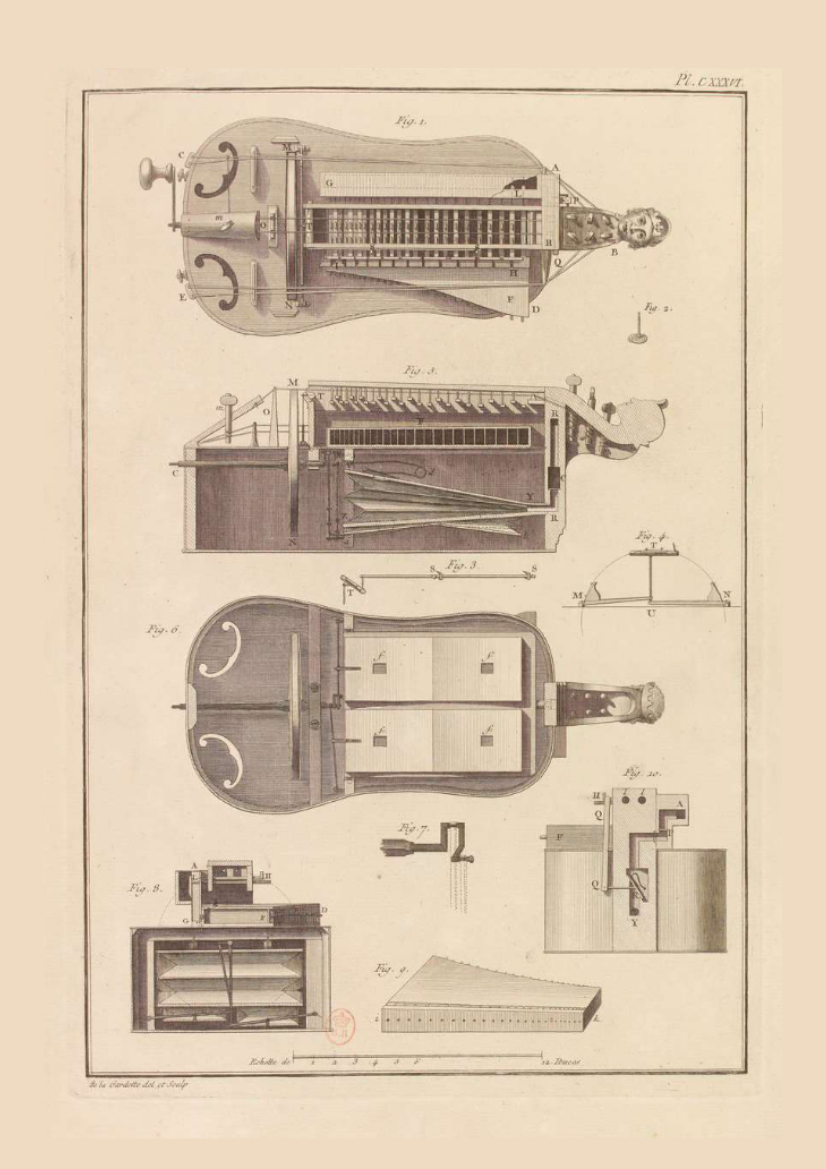
Far from standard, the 18th century vielle organisée was in constant evolution and development – all instruments are however based on the 18th century guitar-shaped vielle, and incorporating a variety of technical solutions by innovative luthiers such as César Pons, Bergé (fl., Toulouse) and Melling (fl., Paris), in order to combine organ and vielle in one instrument. The guitar shape was built to have higher sides, in order to house the bellows and mechanics inside the body of the instrument, which were generally controlled either by turning the crank and wheel, or by the addition of a belt and foot pedal mechanism to operate the bellows. The instrument consisted of a 6-string vielle (however, generally with only one row of tangents – i.e. a single played melody string), combined with one or two registers of organ pipes (sounding an octave above the melody string, with optional second register in unison to melody string, if present) – these could be played separately or together, offering a minimum of three different possibilities (string alone, organ alone, or both together). Placing the organ bellows inside of the body of the instrument had adverse effects on the sound of the vielle, and also made the instrument much larger and more cumbersome than the usual vielle; however, given the large number of instruments surviving today, it seems that the vielle organisée enjoyed great success in the 18th century.
The earliest mention of the vielle organisée is in a text by Carbasus in 1739, where he refers to the possibility of turning two splendid, but unused, guitars into such an instrument (as the guitar was no longer in fashion), thus it must have been in existence at least as early as 1739, if not quite likely somewhat earlier. L’illustre Danguy, undoubtably the most famous vielle player of the time, was reported to have played on a vielle organisée on October 25, 1750, in Lyon – no mention is made of what repertoire Danguy played in that context, presumably from the usual repertoire for normal vielle. The instrument was later presented to the Académie des Sciences de Paris in 1768, by a Sr. Joubert, boasting that his 14 year old daughter had already been playing it for years with success – and with a mention of a “petit jeu de flûtes” which could be played together or independently of the strings. It wouldn’t be until 10 years later, in 1778, that the sole surviving description about the building of the vielle organisée was published, by Dom Bedos de Celles, in “L’Art du facteur d’orgues”, an invaluable resource in reconstructing these instruments.
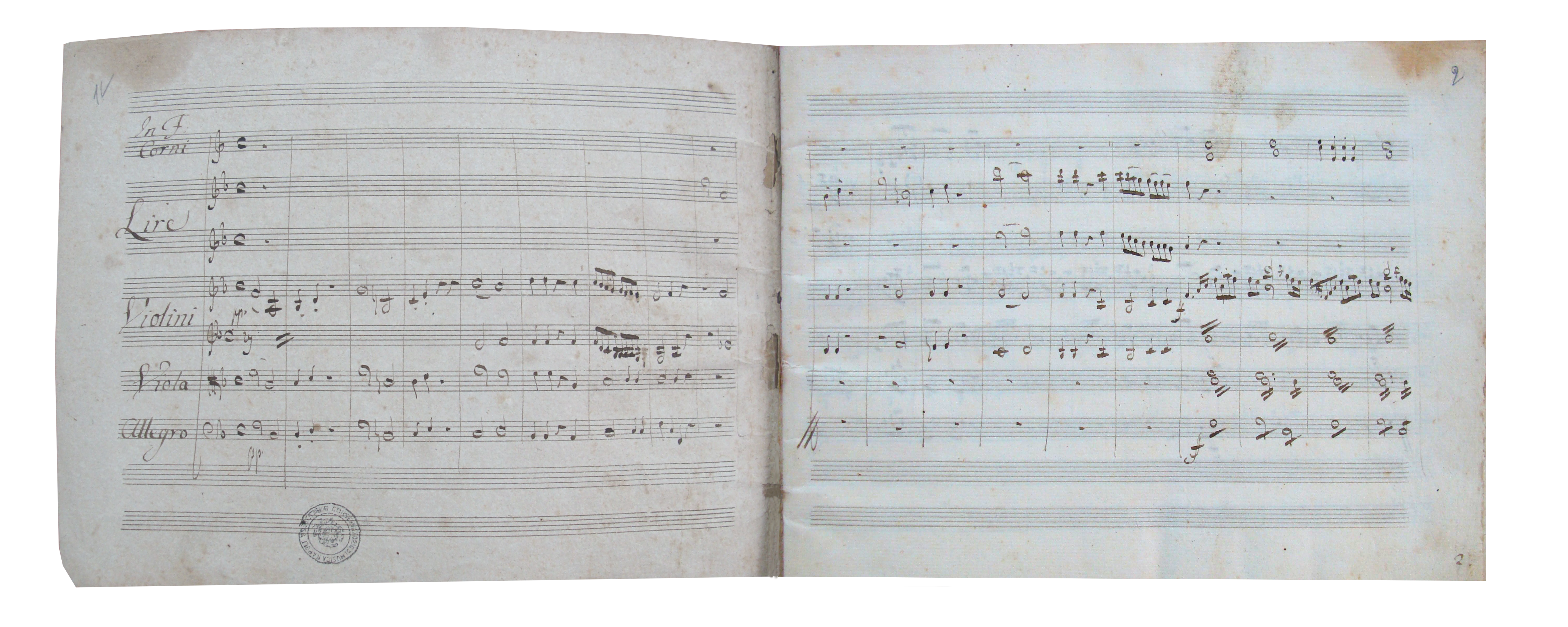
The only extant body of repertoire specifically for the instrument, does not, however come from French sources, but is inextricably linked to King Ferdinand IV of Naples (1751-1825), who himself played the lira organizzata. King Ferdinand IV was, like many monarchs of his day, a fervent patron of the arts, and his instrument of choice was the lira; his teacher was the Austrian pianist and composer, Norbert Hadrava, who was a member of the Austrian Embassy in Naples, in addition to his duties of organising concerts at court, and teaching the king. Hadrava was responsible for commissioning numerous works for the lira, by Franz Sterkel (1750-1817), Ignaz Pleyel (1757-1831), and Adalbert Gyrowetz (1763-1850) – all unfortunately lost, with the exception of two works by Pleyel. The most important extant body of work for the instrument, however, consists of concerti and notturni by two of the most celebrated composers of the time: Joseph Haydn and Wolfgang Amadeus Mozart.
Haydn composed his five (extant) concerti for two lire organizzate in 1786, followed by the eight (extant) notturni, composed between 1788-1790, all of which were written for the king to play together with Hadrava. These works beautifully showcase the capabilities of the lira organizzata, in the format of double concerti (and notturni) with orchestra, and utilising the complete range and possibilities of the instrument. None of these works were composed in Naples – although Haydn was invited to Naples by King Ferdinand IV, he never completed the journey.
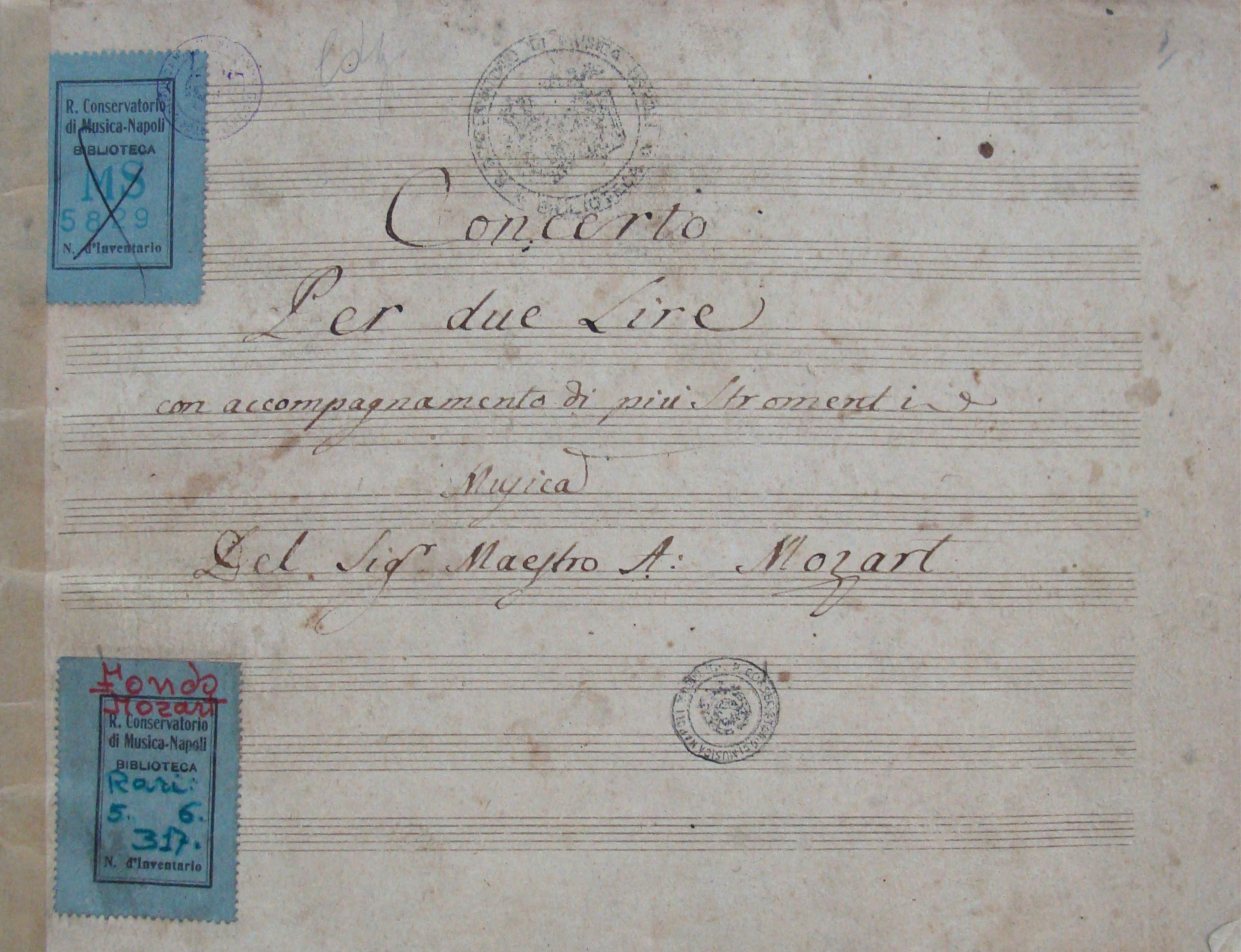
Wolfgang Amadeus Mozart did in fact visit Naples in 1768, at 13 years of age – it is unclear whether the king already played the lira organizzata at this time, and the young Mozart was, in fact, not received by Ferdinand IV. A sole manuscript exists of a Concerto per due Lire in F Major, undated but signed and attributed to Mozart – whether this work is a direct result of that 1768 trip to Naples, a later work, or a forgery remains unclear to this day. Regardless, the style fits Mozart’s writing, and the composer was in close contact with Haydn in the years around 1786 (when Haydn composed his Concerti), in the case that this could in fact be a later work, and not directly related to the young composer’s 1768 visit to Naples.
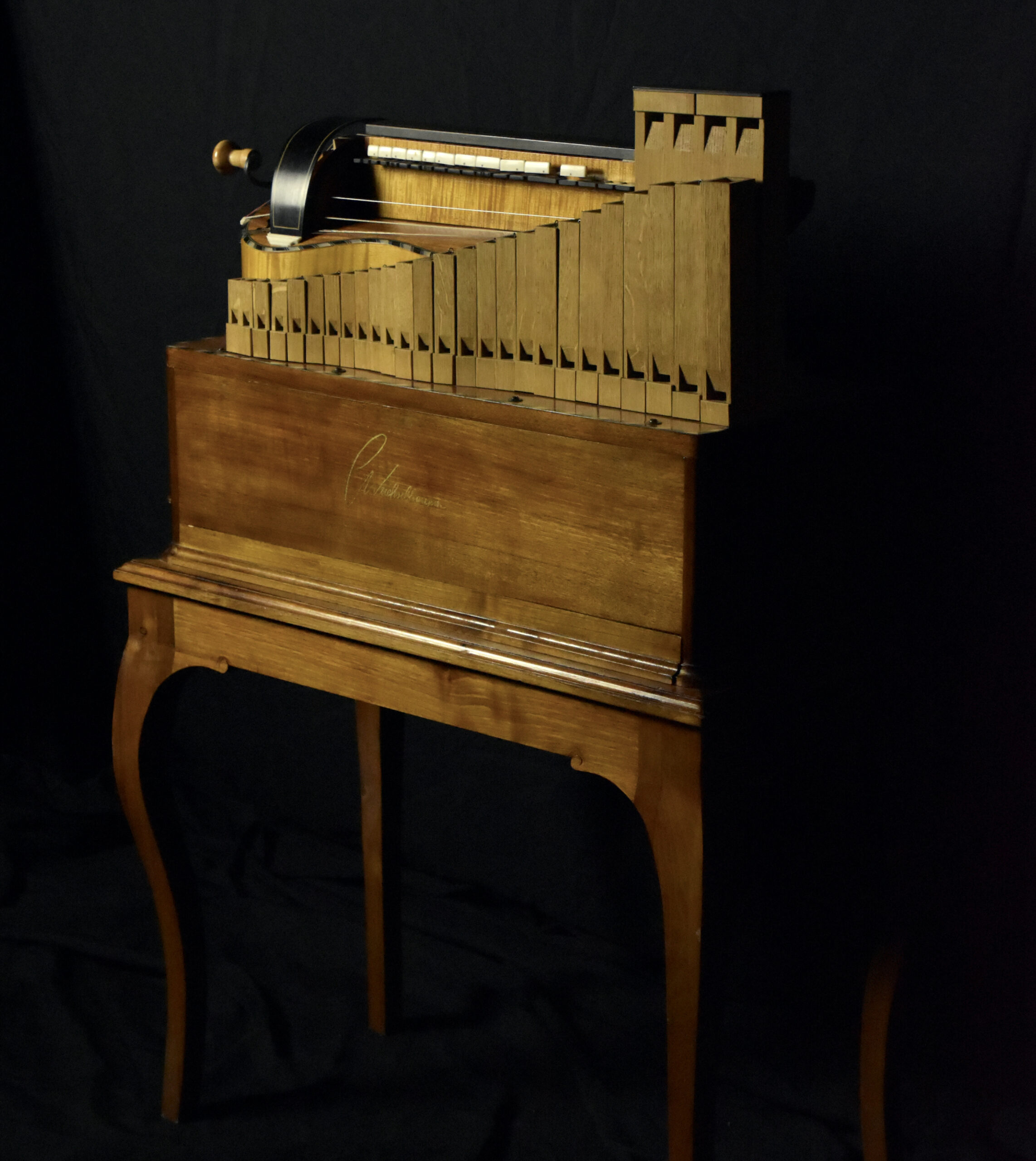
This substantial body of work for two lire organizzate – to be played by Ferdinand IV and Hadrava – poses one interesting problem : these classical concerti and notturni are composed for an instrument with 2.5 octaves, whereas nearly all extant vielles organisées retain the 2 octave range of the mid-18th century French baroque vielle. One single, surviving instrument has the complete range necessary to perform these works of Haydn and Mozart. It is a remarkable instrument, held in the Victoria and Albert Collection (London), and remarkable not only in that it offers a 2.5 octave keyboard, but additionally because the instrument is placed on a table, which contains the organ bellows – thus eliminating the acoustic disadvantages of placing the organ bellows directly inside of the body of the vielle. Whether this particular instrument was the personal lira of Ferdinand IV or Hadrava is unknown, but the point remains that it is the sole surviving instrument presenting the range, characteristics and technical properties to perform the works written by Haydn and Mozart for the king.
With the goal of performing the works of Haydn and Mozart, the choice of instrument to copy was thus an obvious one, pointing directly to the instrument found in the Victoria and Albert Museum in London. This lira is the only extant instrument with the range needed to perform these works, and also offers an elegant solution to the problem of where to place the organ bellows, without detriment to the sound of the vielle itself. Wolfgang Weichselbaumer built several copies of this instrument during the period 2004-2005, taking painstaking measurements of the original instrument, and using the text of Dom Bedos (1778) to reference the technical details. These instruments are the first successful copies of a lira organizzata to date, and have already been played for numerous concerts, as well as two CD recordings (deLirium, 2006 and La lira di Napoli, 2012) on the Laborie Records label. Future plans include further concerts and cd recordings, in order to continue to fully document the works of Haydn and Mozart written for two lire organizzate and orchestra, all composed for Ferdinand IV, King of Naples, to play on his instrument of choice.
– Article by Tobie Miller (Aug 2023)